Published on


3 dynamics at play that give us a glance at a bright future for the discipline.
In a time of uncertainty, job losses, and a never-ending queue of AI-driven restructurings, something surprising is happening: Platform engineering teams are increasingly overwhelmed by the many things they suddenly have to cover and support. Platform engineers are in high demand. We’re currently getting daily requests for whether we know suitable candidates. And if the early signals we’re seeing are true, this might just be the start. We’re observing 3 key dynamics at play here, all driven by the AI revolution.
Dynamic 1: Software engineering goes agentic, platforms need to adopt
Since the very beginning of platform engineering, we built exactly one type of product: the Internal Developer Platform (IDP). And we served exactly one type of user: the software developer. The rise of agents changes that. Agents are really just another type of user. For now, those agents are managed by software developers, but that might change as well. While many architectural elements of platforms remain the same, agents introduce new requirements. Interfaces need to be designed and documented in a specific way; models have to be managed; and checks and balances have to mitigate the risk of hallucination. We call these platforms that are designed for agentic software development Agentic Engineering Platforms (AEPs). Their design depends on the level at which agents are used in the process.
In a recent paper we co-authored for Weave Intelligence, we argue that we differentiate four distinct levels of agentic development:
At Level 1, agents suggest, and humans approve line by line. The platform barely changes. The main job is making organizational knowledge consumable by models.
At Level 2, agents generate pull requests in parallel. The platform must now manage agent identity, sandboxed environments, resource limits, and validation loops. At this level, "Dispatch Work to Agents" becomes a first-class platform capability. Most enterprises are trying to get here.
At Level 3, agents execute in the background. The platform generates work from observed patterns, and humans review exceptions, not every diff. The platform needs robust state management and rules for auto-promotion of low-risk changes.
Level 4 is the horizon. Fully autonomous agents run within guardrails. Early signals exist. Broad field evidence does not. We frame this as an outlook.
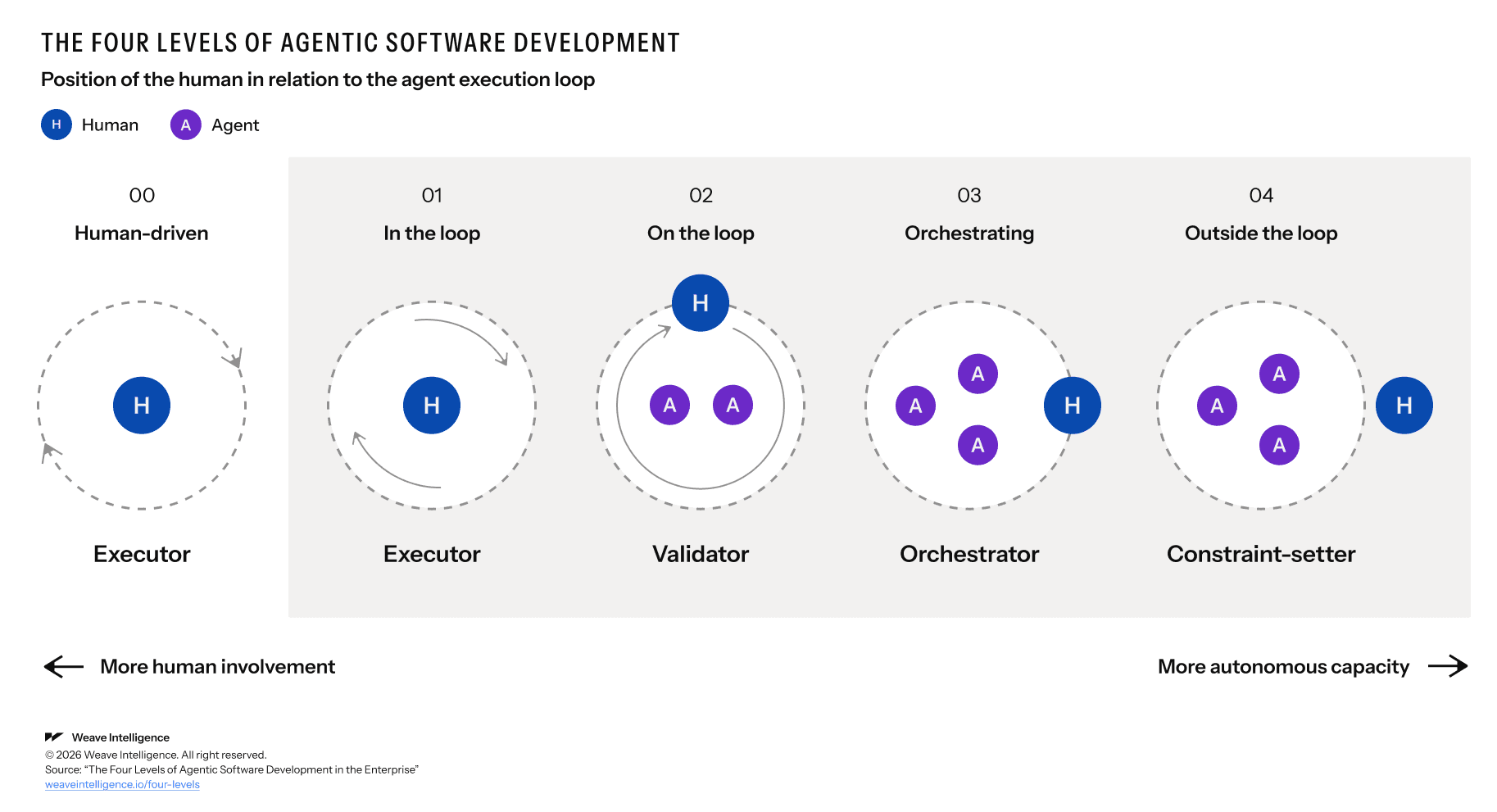
Figure 1: The four levels of agentic software development
Every level up requires more from the platform: more identity management, more policy enforcement, more observability, more cost governance. The platform engineering team that previously maintained CI/CD and environments is now architecting the production system for agentic software development. That alone would explain the hiring pressure. But there is more.
Dynamic 2: New user personas join the scene
Something we’re observing in many conversations with forward-thinking organizations is that, as the Agentic Development Platform becomes capable of operating at Level 3 (agents execute in the background), business users are increasingly asking to use it too. In many cases, leadership is looking to enable everyone across the enterprise to build applications, dashboards, and workflows themselves to unblock and automate their work. The term we’re using for those folks who code without actually being developers is “Enterprise Citizen Developer”. Of course, this requires slightly different interfaces and even more distinct guardrails. It also widens the scope for platform product managers who are suddenly confronted with entirely new use cases. This shift is significant because, for the first time, the platform engineering team is surfacing its importance to the entire business. But this is really just the beginning.
Dynamic 3: Platform engineering is tasked with building the Agentic Infrastructure
And this is the most meaningful shift that will change the fate of platform engineering forever.
Across industries, we’re seeing the same pattern emerge. Business leadership does not just want platform engineering to enable agentic software development and citizen developers. They want the platform engineering team to own the entire AI infrastructure layer that the business runs on.
We call this the Agentic Infrastructure. It is the context layer, vector databases, model serving infrastructure, integration pipelines, identity management for AI agents across the organization, security setup, and governance controls. The Agentic Infrastructure is the foundation that allows marketing to build AI campaign workflows, finance to build automated reporting, and operations to build intelligent process automation.
Why does this land on the platform engineering team's desk? Because nobody else in the enterprise knows how to build platforms as products and thinks in identity, policy, state, paths, and governance at this level of rigor. The data team knows models, the infrastructure team knows compute, but only the platform engineering team knows How to wire it all together into a production system that is safe, governable, and actually used.
What this means
Three dynamics. Three expansions of scope. All happening simultaneously and driven by the same root cause: AI is restructuring how enterprises operate, and the platform engineering team is the only function with the skills and mindset to build the production systems this requires.
While other roles face pressure to automate, the platform engineering team's mandate continues to grow. Their jobs are not just secure. They are becoming more important than ever. We are already seeing PE teams merge with AI and Data groups to facilitate this expanded responsibility.
If you lead a platform engineering team: assess your agentic maturity level, start building ADP capabilities for Level 2, and get ahead of the conversation about citizen developers and the Agentic Infrastructure. These conversations are coming whether you initiate them or not.
The discipline I helped create is entering its most important chapter. I could not be more excited about what is ahead.