The four levels of agentic software development in the enterprise
The four levels of agentic software development in the enterprise




About the report
Software engineering is entering a throughput race. As AI coding agents become a commodity, the real differentiator is no longer which model you use, it's how well your platform governs agent execution at scale. This whitepaper defines four levels of agentic software development, grounded in primary research across hundreds of engineering organizations, and maps exactly how the role of the human - and the platform - changes at each stage.
Inside the report:
Why the bottleneck has shifted from developers to platforms: access to powerful AI models is converging; the competitive edge now lies in how safely and effectively your production system can harness probabilistic intelligence
Why most AI initiatives fail: in a majority of failed efforts, the cause wasn't the models, it was the platform's deterministic fabric failing to provide the guardrails, checks, and balances agents need to operate safely
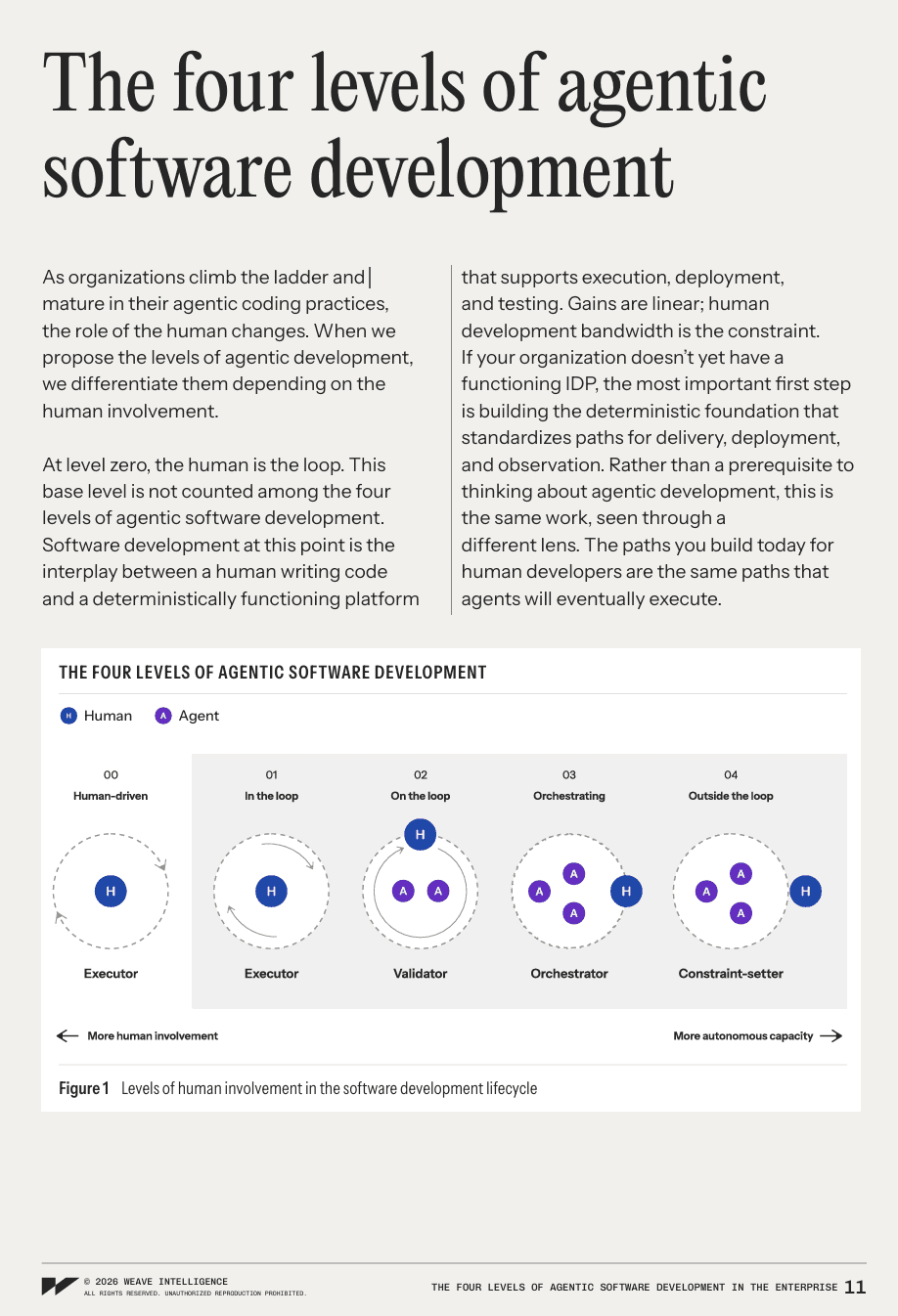
The four levels of agentic development: from Level 1 (human in the loop, agents as coding assistants) through Level 2 (human on the loop, parallel agent execution with automated validation) to Level 3 (humans as orchestrators, continuous background execution) and Level 4 (fully autonomous, self-initiating agents responding to environmental signals)
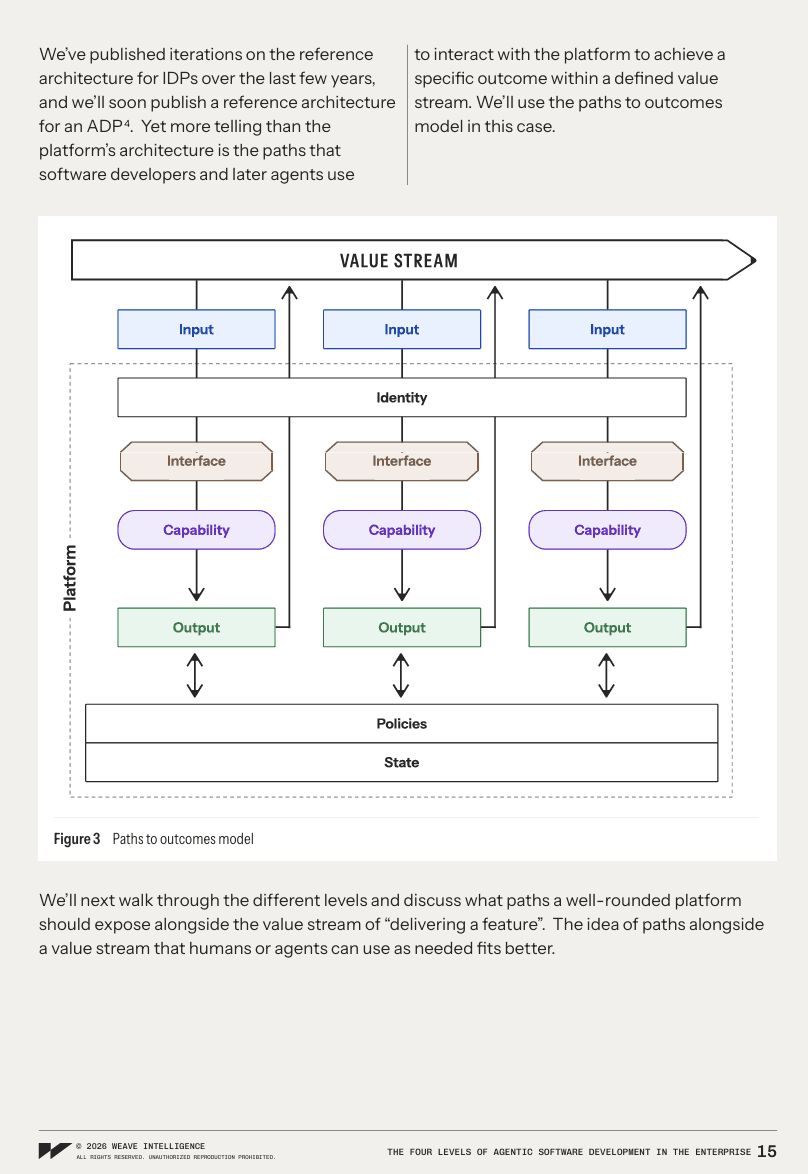
Why the transition from IDP to ADP is non-negotiable: how Internal Developer Platforms must evolve into Agentic Development Platforms that integrate probabilistic systems (foundation models, coding agents) with deterministic systems (CI/CD pipelines, policy enforcement, ephemeral environments)
Software engineering is entering a throughput race. As AI coding agents become a commodity, the real differentiator is no longer which model you use, it's how well your platform governs agent execution at scale. This whitepaper defines four levels of agentic software development, grounded in primary research across hundreds of engineering organizations, and maps exactly how the role of the human - and the platform - changes at each stage.
Inside the report:
Why the bottleneck has shifted from developers to platforms: access to powerful AI models is converging; the competitive edge now lies in how safely and effectively your production system can harness probabilistic intelligence
Why most AI initiatives fail: in a majority of failed efforts, the cause wasn't the models, it was the platform's deterministic fabric failing to provide the guardrails, checks, and balances agents need to operate safely
The four levels of agentic development: from Level 1 (human in the loop, agents as coding assistants) through Level 2 (human on the loop, parallel agent execution with automated validation) to Level 3 (humans as orchestrators, continuous background execution) and Level 4 (fully autonomous, self-initiating agents responding to environmental signals)
Why the transition from IDP to ADP is non-negotiable: how Internal Developer Platforms must evolve into Agentic Development Platforms that integrate probabilistic systems (foundation models, coding agents) with deterministic systems (CI/CD pipelines, policy enforcement, ephemeral environments)
How AI ready is your platform engineering setup?
Benchmark your platform against other teams and get your custom benchmarking score in minutes

Take the survey
How AI ready is your platform engineering setup?
Benchmark your platform against other teams and get your custom benchmarking score in minutes
Take the survey
See sample

Weave Intelligence may collect information about your activity on our website.
To learn more, please read our Privacy Policy.
© 2026 Weave Intelligence
Weave Intelligence may collect information about your activity on our website.
To learn more, please read our Privacy Policy.
© 2026 Weave Intelligence