Available now
By Kaspar von Grünberg and Luca Galante
From the co-creator of the term "Internal Developer Platform" and the host of PlatformCon.


About the Book
The operating model for the modern enterprise
Leading organizations think in platforms. They understand what most still miss: work can be designed, operated, and improved as a production system.
They do not leave recurring work to scattered tools, informal coordination, meetings, tickets, and heroic individuals. They design the system around knowledge work, turning repeated intent into reliable outcomes at scale.
This is the promise of platform engineering.
Thinking in Platforms shows how a practice born in software development becomes a broader discipline for redesigning work itself. AI accelerates this shift. Humans and agents cannot operate reliably inside fragmented systems. They need clear interfaces and reusable capabilities, shaped in a repeatable manner as paths.
For leaders, builders, and operators, this book offers a conceptual model and practical playbook for redesigning how modern organizations work. It applies to the fields of software, marketing, sales, finance, legal, or any other form of knowledge work.
The next productivity wave belongs to organizations that think in platforms.
Part
I
How to Think in Platforms
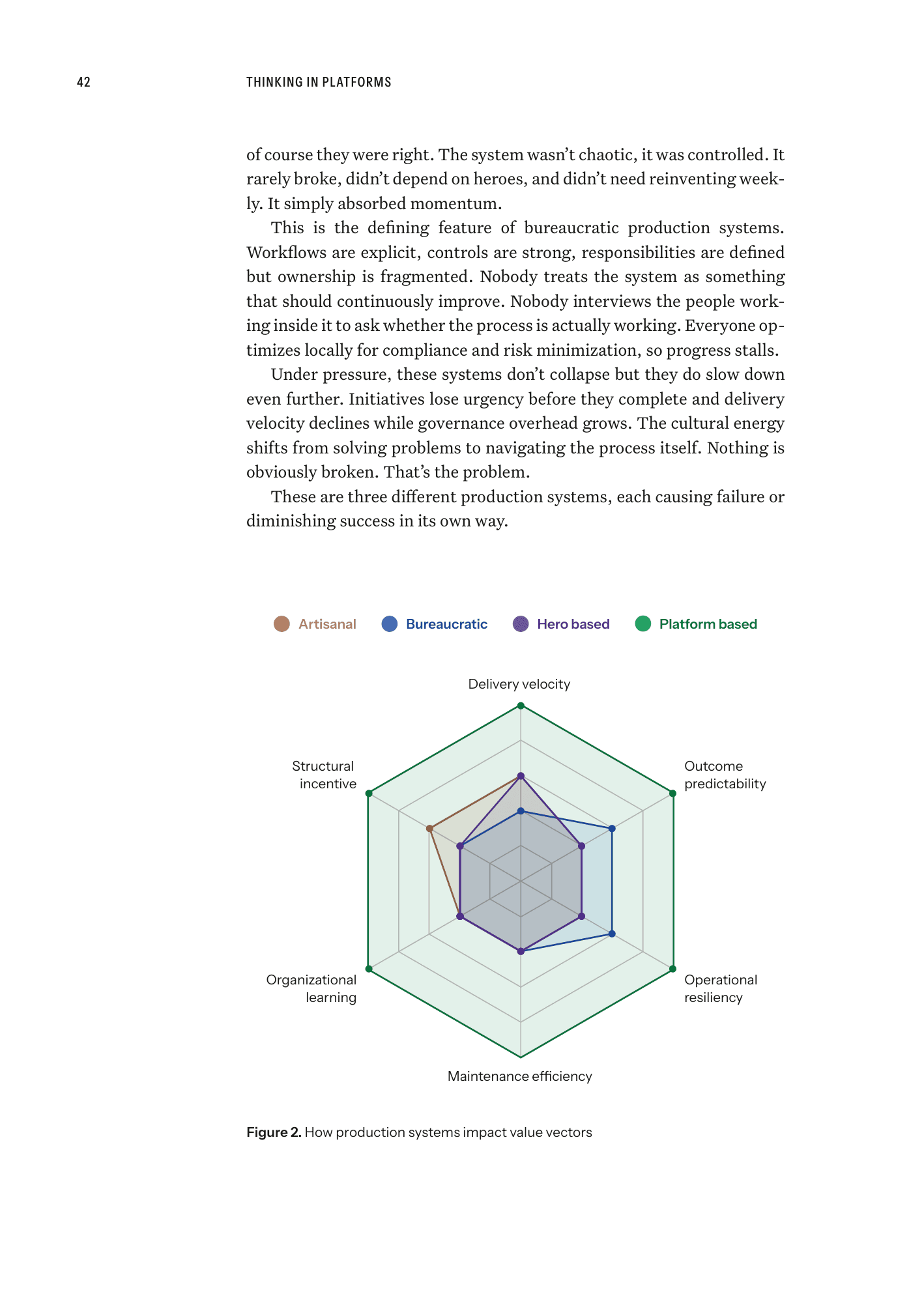
Production systems, misconceptions that block platform thinking, and the value vectors where structural improvement compounds over time.
Part
II
A Conceptual Model of Platforms
The Paths to Outcome model paths, capabilities, interfaces, identity, policy, and state. Applied across software, marketing, and healthcare.
Part
III
The Platform Engineering Playbook
MVP Program → Production Readiness Program → Platform Scaling Program. The 3×3 method, onboarding loop, ROI calculation, and roadmap design.

Inside the Book
Thinking in Platforms delivers a full range of concepts and frameworks, plus the complete platform engineering playbook. It helps platform leaders diagnose where they stand today, introduces the Paths to Outcome model, and walks them step by step through building a Minimum Viable Platform and scaling it all the way to enterprise grade.



The authors
The people who built the discipline

Kaspar von Grünberg
Author
An early pioneer of the platform engineering discipline. Over the past decade he has designed reference architectures, built platforms hands-on with hundreds of enterprise leaders, and coined terms like "Internal Developer Platform" that the field now runs on. One of the few who has built at scale and written the theory to explain it.

Luca Galante
Managing Director, Weave Intelligence
Analyst and community leader in platform engineering. As managing director at Weave Intelligence, he benchmarks how the discipline is practiced across hundreds of enterprises. Hosts PlatformCon: the world's largest platform engineering conference, and writes Platform Weekly, read by more than 100,000 platform engineers every Friday.
What readers are saying

Two of the foremost experts in Platform Engineering, Luca and Kasper, make the strong case for how platform thinking can be the key enabler of consistent, high-quality delivery and time to market of the outcomes your organization seeks. They don’t stop in just making this case, they give an extremely easy to read and consumable playbook to get started with Thinking in Platforms for your consideration. Add in a couple of non-IT examples of Platforms to follow along with throughout the book, and you’ll expand the use cases for Platforms across your org, while bringing new insights in thinking of an Internal Developer Platform (IDP) for your Software Engineering teams.

Jay Moran
SVP of Platform Engineering, Fiserv
GET YOUR COPY
Paperback and ebook editions are available worldwide.
You’ll complete your purchase on the retailer’s website.
You’ll complete your purchase on the selected ebook store’s website.

AI amplifies what you have — it doesn't turn a failing system into a winning one. Organizations only unlock real productivity gains when AI runs on top of clear interfaces, clean data, documented workflows, and deterministic systems. The platform is the prerequisite.
— From the preface of Thinking in Platforms