
Agentic enterprises are organizations in which AI agents autonomously perform most of the tasks previously carried out by knowledge workers. Humans are increasingly moving into the role of orchestrators of agents that guide agents toward business outcomes. For an enterprise to become agentic, its digital work environment must be prepared to support agent operations.
Organizations that reach this state first will gain a significant competitive advantage, as agent-first setups deliver far higher throughput than non-agentic setups. Our recent State of AI in Platform Engineering Report found that 60% of organizations where agents run multi-step workflows reported at least doubling their engineering throughput. That's compared with just 36% of organizations where agents only open pull requests for human approval, a difference of 24 percentage points.
While these findings cover software teams only, we predict a similar pattern will emerge across other business functions.
Consultancies and vendors across the industry have planted a flag on the same hill and given it a different name: Agentic organization, AI-native enterprise, agent-first company, or autonomous enterprise. The number of labels itself is the finding. The industry knows where it is going but can't agree on what to call it. Ultimately, the label is irrelevant.
"Every company, every enterprise, every country would become an AI company, it's going to be an agentic enterprise." - Jensen Huang, CEO of Nvidia @ Dreamforce 2026
Strip away the labels, and they converge on the same principles. Agents participate in the work rather than simply assisting with it. They operate on a governed platform that supports everything, from identity and agent security to observability, models, and their harnesses. Their scope extends across every business function.
What doesn't count as agentic?
Using AI isn't the same as being agentic. To understand the distinction, it's helpful to look at what doesn't qualify as an agentic enterprise. The defining factor is how an organization uses AI.
AI that assists humans through copilots and chatbots may offer some advantages, but that doesn't make an enterprise agentic. The goal is to increase throughput aligned with business outcomes, rather than simply accelerate individual tasks. A scattering of agents built team by team, using different tools without shared governance, doesn’t qualify either. That's agent sprawl, not an agentic enterprise.
Being agentic means equipping probabilistic systems with context and guardrails they need to reason about and act on them. Agents can then use the tools available to them to perform actions autonomously.
Your engineering teams will likely be the furthest along in their agentic enterprise journey. However, using AI to develop software doesn't automatically make your organization agentic. Productive AI adoption must scale across all business functions, requiring the systems that support them to be ready too.
Most enterprises aren't agent-operable yet
There's a whole set of prerequisites necessary to make an agentic enterprise a reality. Most organizations simply aren't there yet and have plenty of clean-up work ahead of them.
Think of the flow of work in an organization as a sequence of paths. A support escalation is a path. So is closing the books or onboarding a supplier, along with getting a change into production. Paths are the units of recurring work, and most aren't documented. Instead, they’re held in the heads of the people who just get 'em done, day in, day out.
This classic example of tribal knowledge makes finding your way around difficult as a human and almost impossible as an AI agent. If you're an intern going through onboarding, you can ask your senior colleague or read internal documentation. You can also pair with others. An agent, however, doesn't have the same ability to navigate undocumented processes.
To overcome this challenge, the systems agents operate in must be prepared to support them. Even the most brilliant model, capable of solving Olympiad-level math problems with perfect information, will struggle with incomplete information or an unsuitable operational environment.
An environment is ready for agents when it is legible, known, capable, and checked:
Legible: The context is documented and machine-readable, including the service graph, ontology, and rules. Nothing an agent needs lives only in someone's head. An agent working with unreliable will only repeat your mistakes faster.
Known: Every agent has a defined identity and scope, along with a budget. What it can access and spend is determined before it acts. As agent fleets grow, these controls become increasingly important for managing the associated risks and costs.
Capable: Tools and systems are accessible through interfaces an agent can call with defined contracts, allowing them to take action.
Checked: Output is evaluated against a definition of done, with failures feeding back into the process. Agents can iterate safely until the gate passes instead of being trusted once.
"Every AI-powered workflow now carries an operating cost, and every agent inherits whatever is wrong with the data underneath it. The organizations doing this well start with the data rather than the model, and they treat governance as an architectural property rather than a policy document. The challenge is no longer how to build agents. It is how to govern the resources they consume." - Shayan Mohanty, Chief Data and AI Officer, Thoughtworks
Becoming agentic with platform engineering
Key to understanding how to make an enterprise agentic is to understand the discipline of platform engineering, which originated in IT but is now spreading across the enterprise. As the name suggests, platform engineering focuses on building digital platforms that help humans and, increasingly, AI agents automate the non-value-adding parts of knowledge work. At its heart, platform engineering is about identifying repeatable paths andautomating workalong a value stream to deliver business outcomes. The Paths to Outcome model captures this approach and forms the core of the platform engineering methodology. A path is the repeatable route from user intent through interface to usable output. Using paths used along a value stream creates a business outcome.
The Paths to Outcome model from the book Thinking in Platforms is simple. A request arrives. It makes its way through one or more capabilities the organization owns, and produces a usable output.
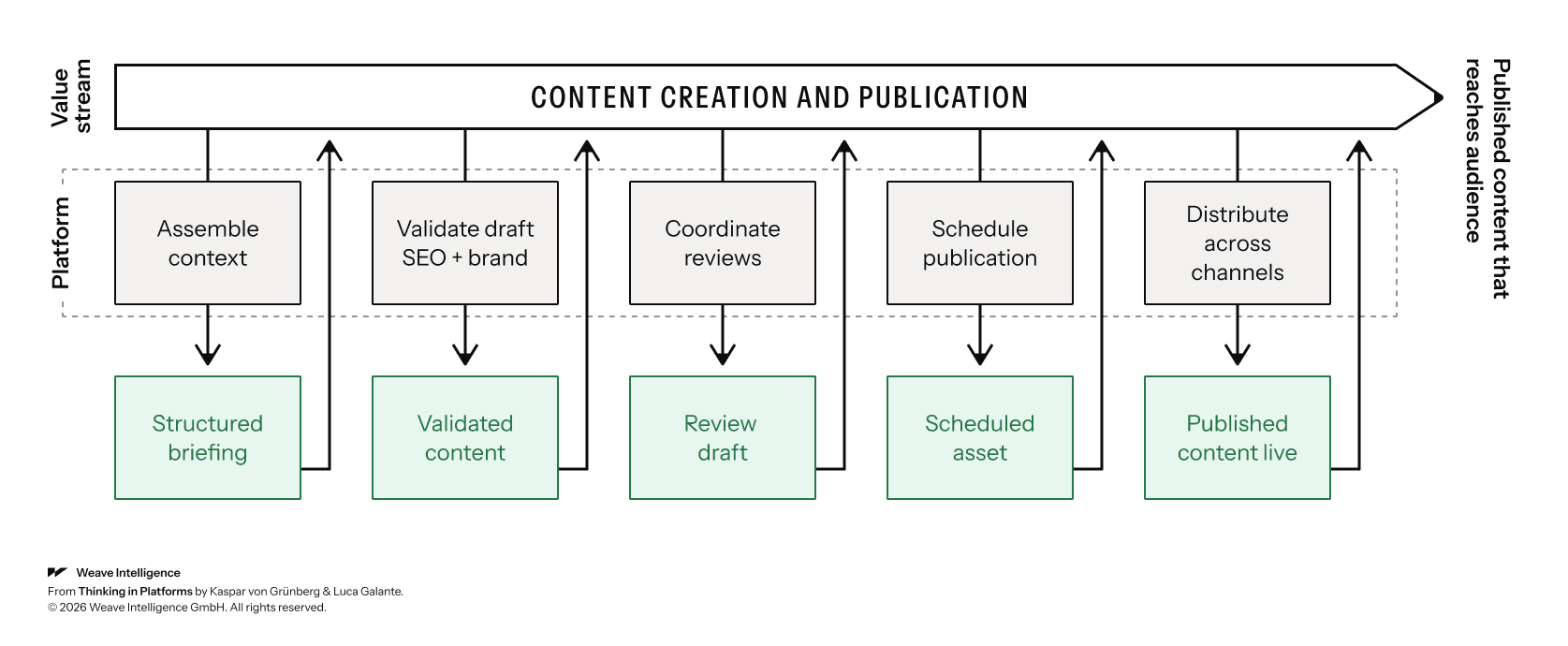
Figure 1: The Paths to Outcome model for a content creation and publication value stream designed for humans and aimed at the outcome of "published content helps the audience.
An agentic enterprise makes these paths to outcome machine-executable with governance built in. The same rules apply whether a human executes them.
In an agentic enterprise, these paths are designed with agents as their primary users.
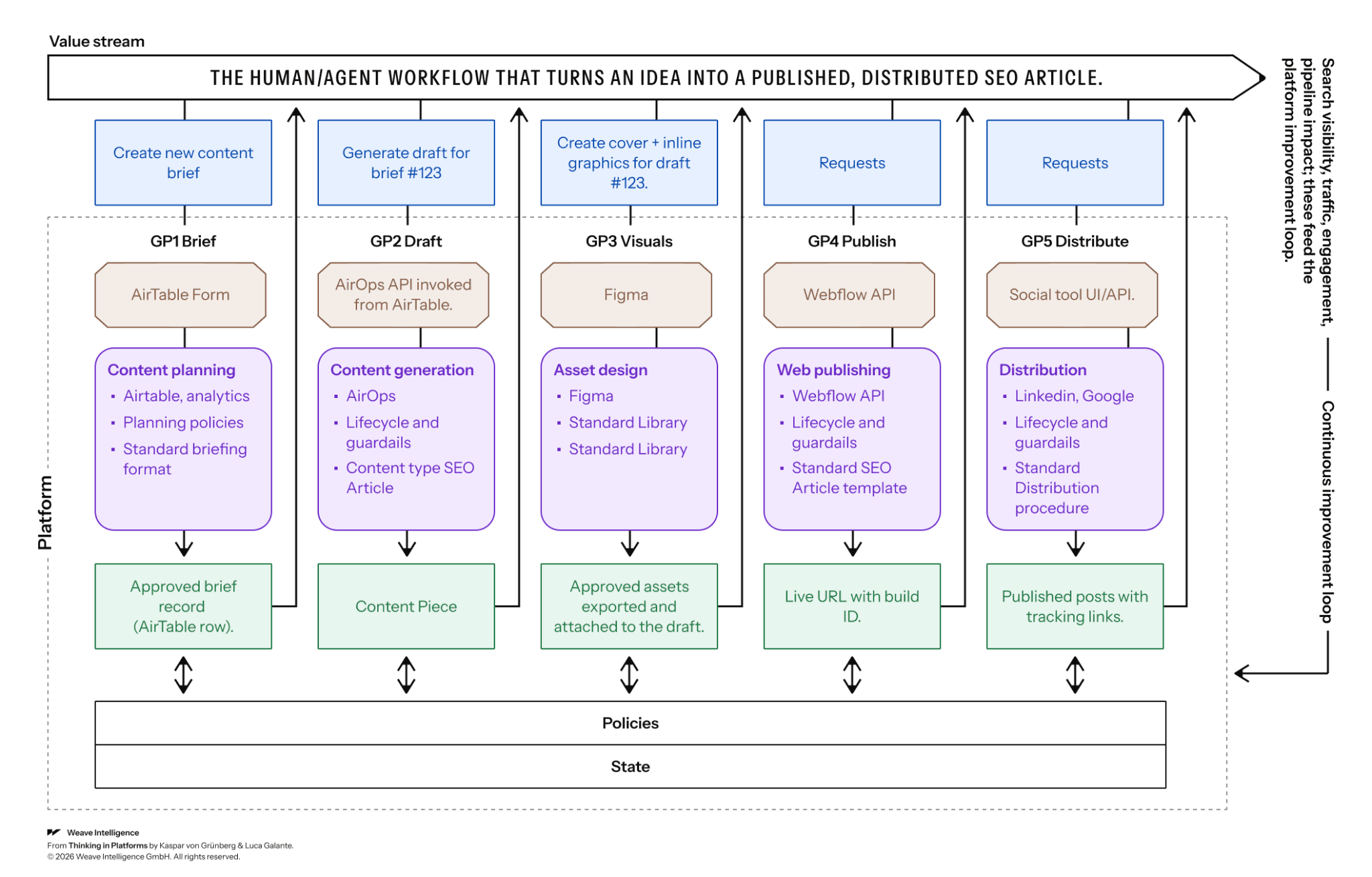
Figure 2: The Paths to Outcome model of an agent-first setup powered by AI capabilities.
Wherever possible, agents now perform these tasks. Humans may still oversee the process by orchestrating the paths and reviewing agent outputs while the agents carry out the work.
What sets an agentic enterprise apart is having a system for identifying paths and enabling agents to execute them, then applying that system consistently. Teams work function by function to identify recurring tasks, documenting each route as a specification with defined inputs and outputs. They then determine whether the path should run deterministically, probabilistically, or as a loop combining both approaches. Once complete, they move on to the next path.
The foundation: an agentic platform
Preparing the digital environment for agents requires organizations to build an agentic platform that supports secure operations. The platform provides the agent infrastructure, comprising models and the harness (the operating system of a single agent) supported by governance (the steering and management system for multiple agents covering identity, security, and observability).
While agent capabilities vary by business function(an agent used in sales will operate very differently from one used in software development), they all share the same foundation: the agent infrastructure.
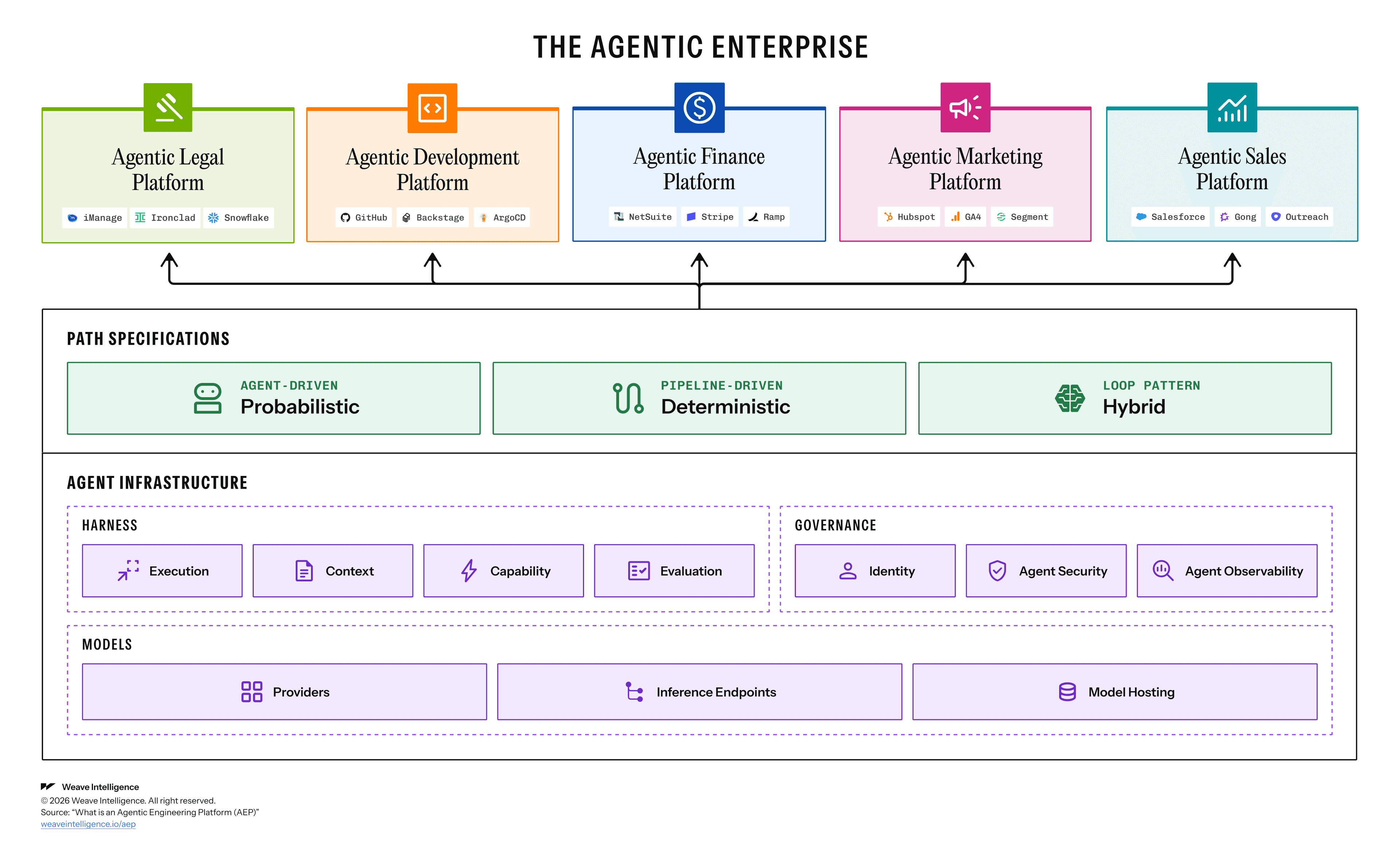
Figure 3: Reference architecture for agentic platforms across business functions, showing the shared agent infrastructure.
The responsibility of building these platforms lies with the AI platform team, which primarily focuses on developing the agent infrastructure. The team works with the business to formalize repeatable paths using agents and AI-powered workflows built on top of the platform.
So the questions are: how do we, as an organization, build the foundational platform that agents run on and bring the vertical units onto this platform?
The answer to the first part lies in the experience your IT organization has gathered over the years when building its Internal Developer Platform. These teams have spent years building digital platforms to streamline and standardize work. They’re perfectly positioned to build the technical foundation that allows agents to scale securely across the enterprise, with the necessary guardrails and security frameworks in place. The traditional platform team is now evolving into an AI platform team. And the product they are building is an agentic platform, with a shared foundation that supports agents across every business function.
The second question concerns onboarding business units onto the platform and preparing their value streams to run on it. Doing so requires significant change management and collaboration with technical teams. Becoming agentic is therefore a leadership priority rather than simply an IT project. Every function head has a stake in deciding which of their paths are handed over to agents.
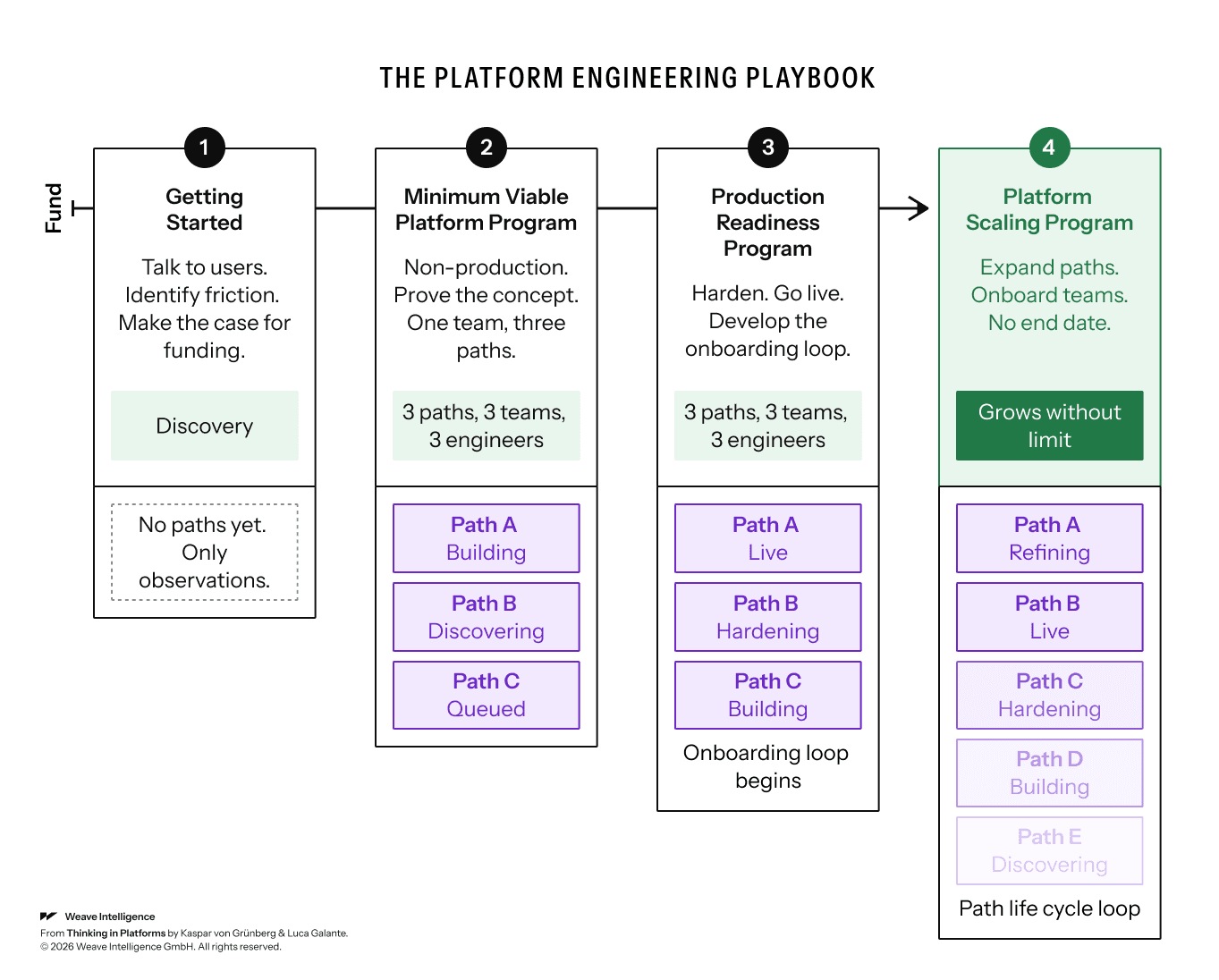
Figure 4: The Platform Engineering Playbook takes an incremental approach to building platforms. It starts with an MVP and consistently scales to a production-ready version.
The Platform Engineering Playbook from our recent book Thinking in Platforms offers a consistent and battle-tested approach to building platforms that work at scale. It starts small: identify the first three paths to automate and select three teams to test them, supported by a team of three to build the first Minimum Viable Platform (MVP). The playbook then provides a structured approach to planning adoption and production readiness, followed byroll-outs at scale.
If you’re serious about transforming your organization into an agent-first enterprise, understanding these principles of platform engineering is the best place to start.
