
AI in the Enterprise keeps failing. Your agents are not delivering the productivity revolution you were promised, and it is not the model's fault. They fail because there is no platform underneath them. That problem was already solved once, by a community of 280,000 platform engineers in software development, and there is a proven, step-by-step method to solve it again in any other function of your enterprise.
We're at the advent of an industrial revolution triggered by the rise of artificial intelligence. In the first industrial revolution, we had to redesign the flow of producing goods; in other words, we built factories. Today’s revolution is about the industrialization of knowledge work. We now need digital factories in which agents can write software, build marketing campaigns, and draft legal contracts. Those digital factories for agents are called Agentic Platforms. If we don't build these platforms, AI roll-outs in the enterprise will keep failing. Your agents will not deliver the productivity revolution you were promised, and the reason will not be the capability of the model but the fact that there is no "factory", or in other words, a platform, on which they can operate effectively and securely.
Building digital factories is nothing new. Software teams have built so-called Internal Developer Platforms for a decade. There's a whole discipline around it called platform engineering, with its own growing community and conference. There are playbooks, methods, ways of reasoning, and ways of planning.
Platform engineering is now expanding across verticals as enterprises need to put agents to work.
So, let's first explore why exactly agents need a platform to operate on, and second, how platform engineering can help us get there.
First, to the question of why you need a platform, concretely an Agentic Platform to put agents to work productively. To make the case, let's assume you've hired an incredibly smart intern, just out of the Ivy League, bursting with drive. This person lands in an environment optimized for humans. The interfaces, documentation, meetings, and capabilities of the workplace have been refined for decades to let people do their work optimally.
You skip their onboarding and, weeks later, wonder why they are slow, and why all the tasks you have given them are full of errors and strange conclusions.
From that perspective, it's pretty clear why our smart intern failed, right? Onboarding to an environment they barely had a chance to understand isn’t a recipe for success.
Now here is the thing. That intern at least landed in a world built for humans. Your agents do not even get that. Today, you onboard them to a world made for people: documentation (if it exists) written for John Doe, interfaces that are hard for a machine to consume, and guardrails that are tribal knowledge in the heads of a few colleagues. Your agent will hallucinate and constantly get stuck; you will be unhappy.
What you need is an environment for agents to work in. That system is the missing piece: the standards written down, the policies made explicit, the interfaces machine-readable, the context there, and an easy, reliable, repeatable way to get things done.
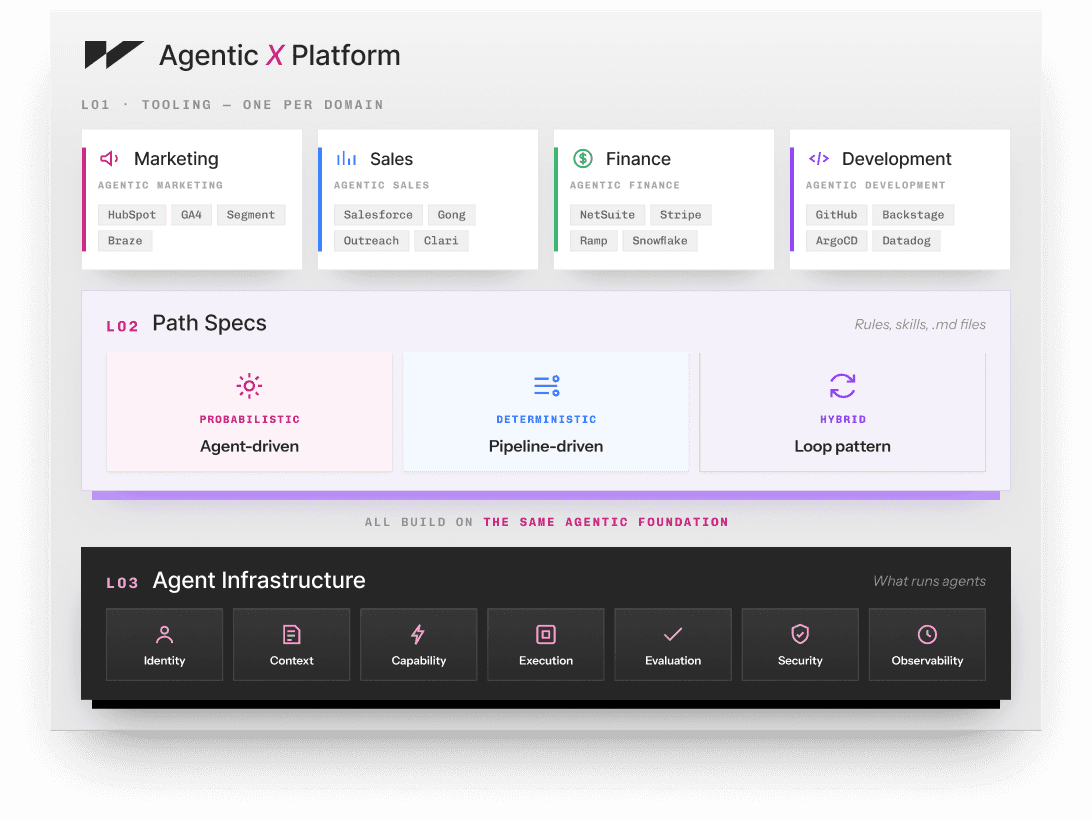
That structure, encoded into the system and offered at scale, is what we call an Agentic Platform. Agentic Platforms come in many different shapes. Most common already are Agentic Development Platforms, but we are seeing Agentic Sales, Marketing, and Finance Platforms popping up left and right.
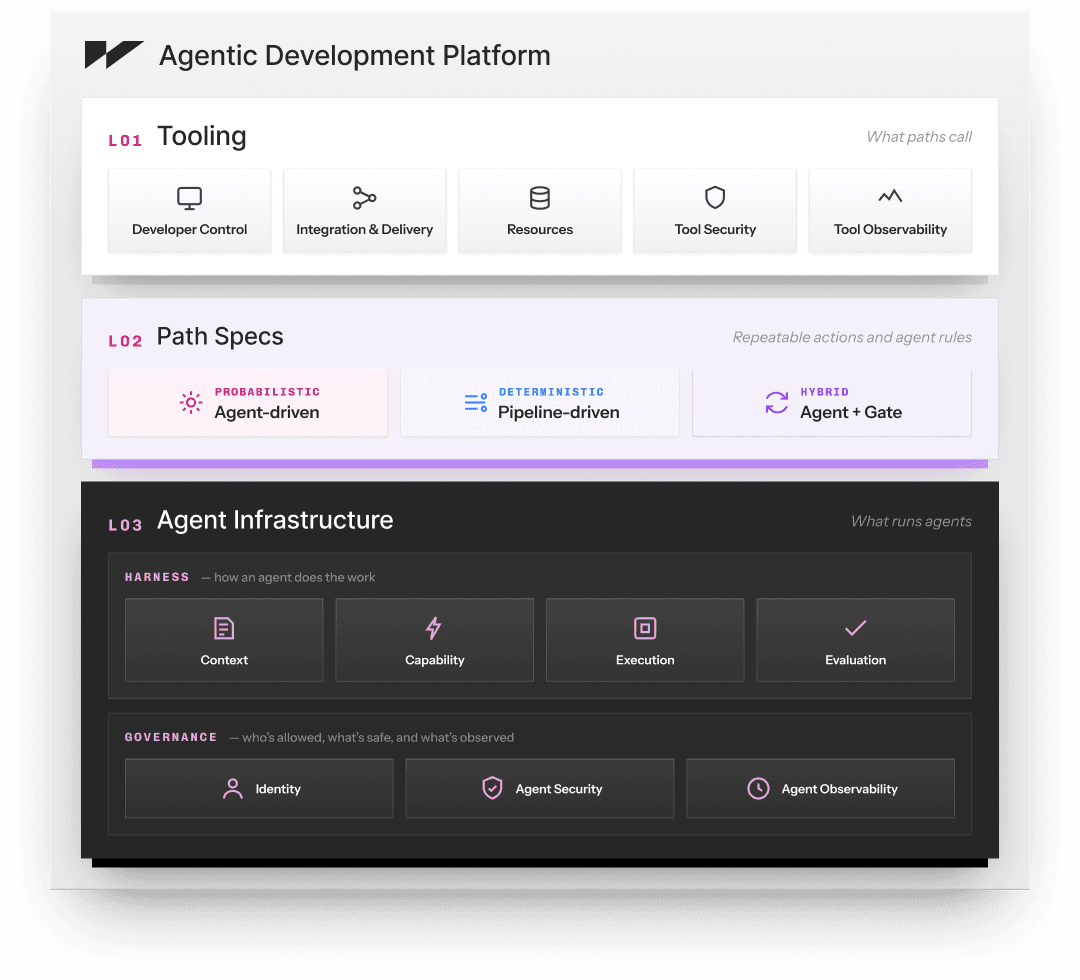
So here is what a platform actually does. It takes a recurring intent, "get this campaign approved and live," "provision this environment," "close this part of the books," and turns it into a reliable, repeatable Path: the context, standards, the approvals, and the policies built into the system itself, so work moves from intent to outcome without ten tickets and five sign-offs. It is not a tool you buy. It is the productized system around recurring work, and it is what gives both your people and your agents something solid to stand on.
It's not a trivial piece of tech. In the end, you will need your software and IT team to supply the agent infrastructure to the vertical teams, who then wire their tools on the tooling layer and codify the repeatable paths the agents can use.
So that's what a platform is. Now, how can the discipline of platform engineering help you transform your operation and organization into a platform-first environment that can thrive in this industrial revolution?
The good news is that you do not have to invent any of this. The method already exists, it has a name, and it has been stress-tested for a decade in the most demanding environment for this kind of work: software development. It is called platform engineering, the discipline of building, running, and continuously improving platforms for knowledge work. Here is why it is exactly the method you need to industrialize your own function.
It treats the platform as a product, not a project. This is the single most important idea in platform engineering. A project has an end date, gets handed over, and rots. A product is owned for good, built around its users, and improved through their feedback. An Agentic Platform is never finished. Your tools change, your agents change, your policies change. Only a product mindset survives that, and platform engineering is built entirely around it. Your users now include agents, and it turns out that designing for agents is remarkably close to designing for people.
It starts small and scales deliberately. The biggest reason platform efforts fail is that they start too broad, too many users, and too many problems all at once. The platform engineering playbook does the opposite. You begin with a Minimum Viable Platform (MVP), a handful of engineers codifying a handful of paths for a handful of teams. You prove real value, harden it into something production-ready, and only then scale it team by team and vertical by vertical. No big-bang transformation, no year-long budget you have to defend before anything actually works.
It gives you a single model that works across every vertical. Platform engineering comes with a shared way of reasoning about platforms, the Paths to Outcome model, that holds regardless of whether your users are developers, marketers, controllers, or agents. The surface looks completely different across functions, but the structural question is always the same: how do you turn a recurring intent into a reliable outcome through well-designed paths and clear interfaces? That is why a discipline born in software transfers cleanly to marketing, sales, finance, and operations. And that’s why soon, enterprise after enterprise will be developing AXPs, Agentic Platforms for all the different verticals.
It fixes the structure, not the symptoms. You cannot buy your way out of a broken operation, and you cannot hire your way out of one either. More tools and more people leave the underlying system untouched, and the same failures keep coming back. Platform engineering redesigns the system itself, turning tribal knowledge into paths, scattered tools into capabilities, and one-off heroics into something owned and repeatable.
And you do not do this alone. You build teams of platform engineers in every department, people who treat their function's platform as a product and tune it continuously. You do not need an engineering degree to be one. You need product thinking and a clear view of the work.
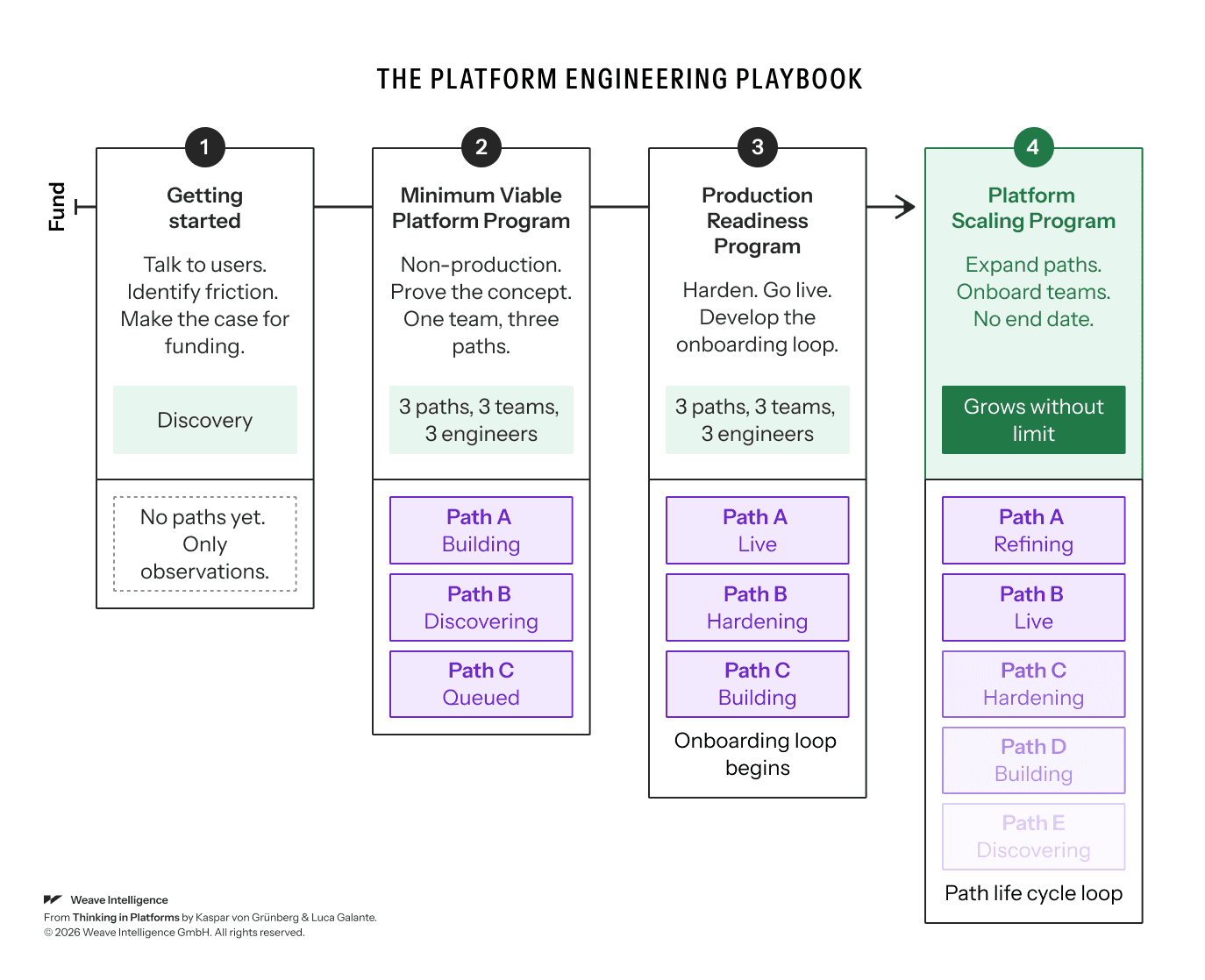
All of it is written down. Our upcoming book, Thinking in Platforms, is the end-to-end guide to building and scaling platforms, and the Platform Engineering Playbook gives you the concrete, step-by-step method to get started. Read, then build your first platform.
The industrial revolution of knowledge work is here. The teams that think platform first will win it. Go for gold!