
We are witnessing the fastest rate of adoption in technology history. Yet, that deluge comes with it a paradox. While 89% of platform engineers now use AI daily and 94% of organizations identify it as critical to their future, according to [the State of AI in Platform Engineering Vol.1](https://weaveintelligence.io/research/state-of-ai-in-platform-engineering-2025) for the majority of enterprises, ubiquitous adoption has not translated into any kind of clear, measurable, reportable strategic value.
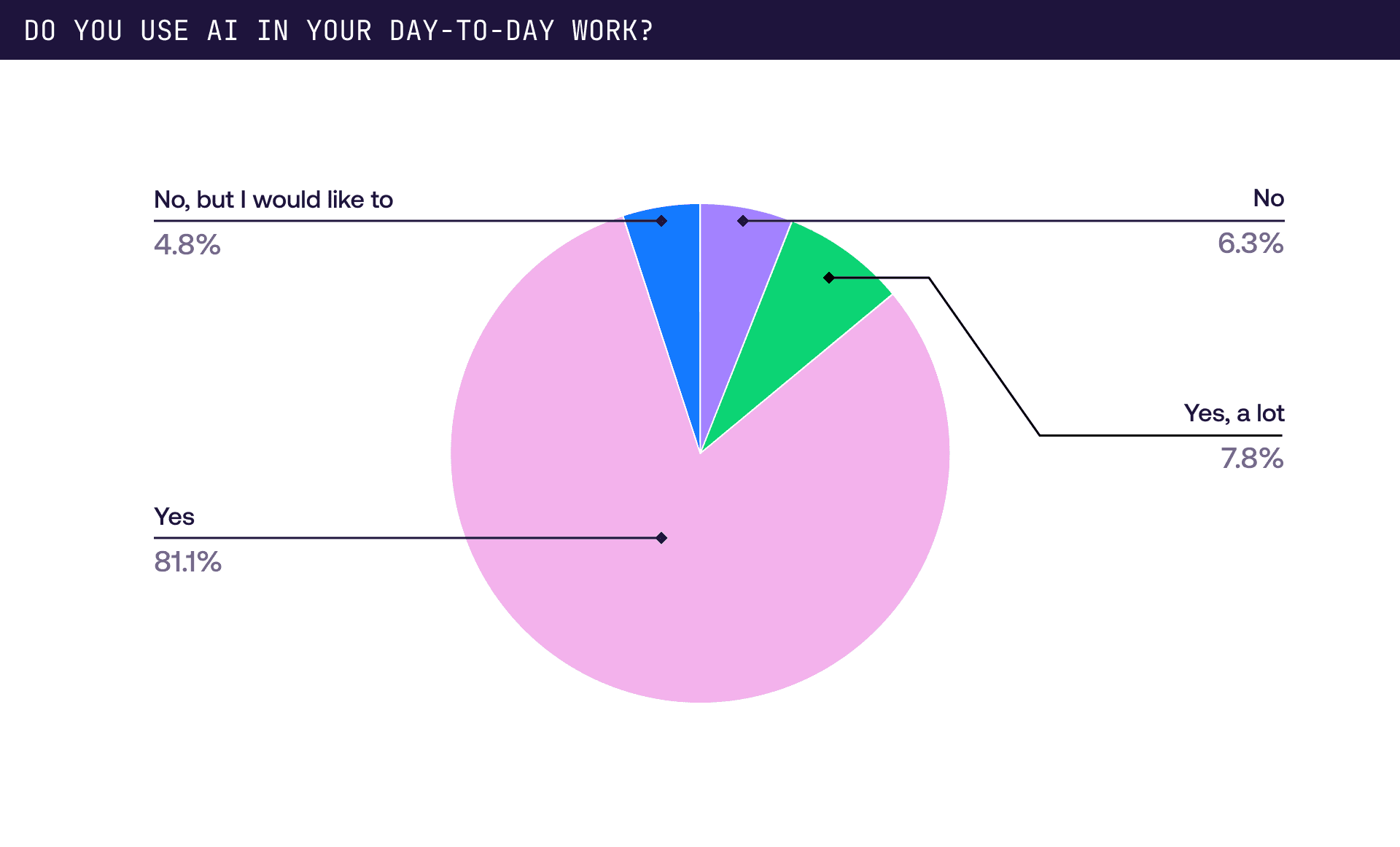
Why? Because overwhelmingly, current AI usage across the industry is tactical, fragmented, and largely unmeasured. It is driven by individual experimentation, engineers utilizing coding assistants to generate billions of lines of code, rather than coordinated or thoughtful intent across the enterprise. This grassroots explosion has driven adoption rates better than any other product in history, but it has brought with it more than just unrestrained expectations, and mountains of tech debt, but a deluge of "Shadow AI", uncoordinated tool usage that bypasses governance, creates sprawl, and obscures true ROI.
There is more to the story however. Far beyond the doom and gloom. Our research, the State of AI in Platform Engineering report, corroborated by the 2025 DORA report confirms a fundamental truth. You can succeed at AI. That success brings with it unbelievable productivity and potential. And that success comes from platform engineering.
Confronting the "AI implementation plateau"
First, let's understand the problem facing almost 95% of organizations. Enterprises are hitting a brick wall. After the initial excitement of coding assistants, they encounter the "AI implementation plateau", a gap between the potential of AI and realized business value. Software engineering teams, and particularly their leaders have been dazzled by the rapid availability and power of LLMs. And so, rather than deep, thoughtful and strategic applications of their use, many organizations simply mandate "use AI", with the expectation that ROI will simply appear.
The symptoms of this plateau are unmistakable. Leadership leans on vanity metrics like lines of generated code instead of measuring real usefulness or business impact, obscuring true ROI. At the same time, developers suffer from prompt and review fatigue caused by uncoordinated tool sprawl and constant context switching, and organizations face integration paralysis, where monolithic architectures and accumulated legacy debt make it nearly impossible to operationalize AI beyond isolated prototypes.
All while governance and security risks grow as "Shadow AI" usage bypasses controls, sensitive data is exposed through unmanaged prompts and integrations, and policy enforcement lags behind adoption. With limited observability, teams can't reliably trace model behavior, understand failure modes, or attribute cost and value, while the explosive growth of AI-generated code overwhelms testing capacity, creating a widening gap between what can be produced and what can be verified, secured, and maintained.
So how does platform engineering solve this?
How platform engineering ensures AI success
A mature platform engineering organization will almost always have these 12 fundamental capabilities built as easy to use, effective and streamlined golden paths for platform users. These capabilities, referred to as "table stakes" by Rickey Zachary, Global Platform Lead at Thoughtworks are the core functionality of any successful platform engineering initiative.
They are:
Platform product thinking: Operates the platform like an internal SaaS product, with clear ownership, user research, roadmapping, documentation, and enablement to drive adoption and outcomes.
Enterprise architecture: Embeds proved architectural patterns within the platform, such as landing zones, identity and access, network baselines, and paved roads.
Infrastructure automation: Enables consistent, repeatable provisioning of environments and resources at scale.
CI/CD pipeline management: Automates build, test, and deployment flows to deliver software reliably and frequently.
Developer Experience: Provides self-service tools and workflows that reduce friction and cognitive load for developers.
Testing platform: Supports automated, scalable testing to ensure quality, performance, and reliability.
Security & compliance: Embeds security controls and compliance requirements directly into platform workflows.
Observability: Delivers visibility into system health, performance, and behavior through metrics, logs, and traces.
Container platform: Standardizes how applications are packaged, run, and secured using containers.
API management: Governs how services are exposed, documented, versioned, and secured.
Cost management: Makes cloud and platform spend visible, optimizable, and accountable.
Governance & controls: Enforces standards and policies automatically while preserving team autonomy.
The building of golden paths to enable these capabilities provides the perfect foundation to accelerating the benefits of AI, and managing the challenges. It is thus no surprise that enterprises with platform teams are far more effective at smashing through the AI implementation plateau and delivering clear business value rapidly and consistently.
The dual mandate: Platform Engineering as an AI Enabler
This success has led platform teams to accept a new "dual mandate." It is no longer sufficient to simply use AI for efficiency; the platform team becomes the architect of the AI-enabled enterprise. This responsibility splits into two non-negotiable streams:
AI-powered platforms: Leveraging AI to automate toil within the Internal Developer Platform (IDP). Improving the platform and platform teams effectiveness. This includes things like AI-assisted provisioning, automated code reviews, and natural language interfaces that democratize infrastructure access.
Platforms for AI: Building the "golden paths" for a new, demanding customer persona: the data scientist and ML engineer. Alongside platform teams managing new and specialized ecosystems for MLOps, model governance, feature stores, and data versioning.
These mandates are symbiotic. A platform team that uses AI for its own productivity but fails to provide the infrastructure for the organization's AI products is actively failing the business. Platform teams need to adjust to this new responsibility and embrace it.
As the industry evolves from cloud-native to "AI-native." Traditional cloud-native abstractions, designed for CPU-centric, general-purpose workloads, are becoming increasingly insufficient for the demands of modern AI. This is because AI-native infrastructure demands a fundamental architectural rethink. It requires global GPU orchestration, composability to swap resources seamlessly, and deep compute architectures capable of handling massive data flows via high-speed networking like Ultra Ethernet.
To manage this, platforms must become the translation layer between AI ambition and operational reality. Teams that treat AI infrastructure as an add-on will bottleneck delivery, inflate spend, and increase risk. While the winners will be the platform organizations that make AI-native capabilities self-service, standardized, and continuously evolvable, so experimentation can scale safely across the enterprise.
Many futures, all dependent on platform engineering
The future of AI in the enterprise covers many different paths. One such path is the rise of self-evolving platforms, where agentic systems operate independently to perceive, plan, and execute tasks probabilistically rather than following deterministic scripts. Another is the emergence of Enterprise Citizen Developers, where AI application creation is democratised beyond software engineering teams to the wider organization, as anyone internally or externally can use AI development tools to create their own specialized microapps.
Whether it is accelerating the usage of AI amongst developers, the wider organization, supporting the building and managing of AI models and AI/ML teams, platform engineering is a fundamental layer through all of this.
If this comes to pass, and it seems almost certain it will, the role of the platform engineer expands profoundly. All AI usage requires guardrails, governance, testing, all the rest of the 12 capabilities listed above.
This is not an idea for the far future. We are already seeing "background agents" that handle refactoring and migrations in parallel with human work. We are seeing Enterprise Citizen Developers across more and more organizations build their own microapps.
Those that invest in platform engineering as the foundation for an AI-native enterprise will unlock the incredible potential that AI promises. And as agentic systems reshape how software is built and operated, the platform will only grow in importance to become the control plane for innovation. While at the same time your platform engineering team, becomes one of the most strategic capabilities an organization can invest in.